01 / The problem
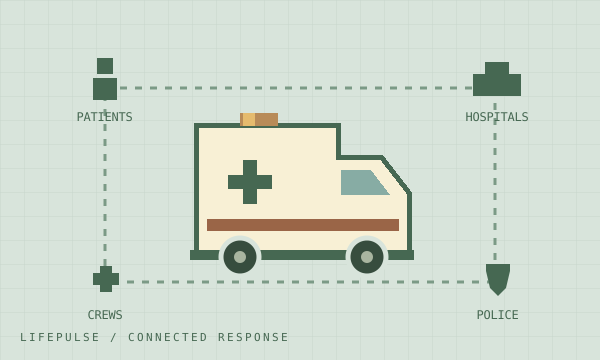
An emergency ambulance request involves more than a vehicle. Patients need to request help, ambulance crews need trip information, hospitals need notice of incoming patients, and traffic police need information to coordinate the route.
02 / One connected response
LifePulse is an emergency ambulance calling and tracking prototype built around these four groups. Separate dashboards give each group a view of the same response workflow.
- Patients: request ambulance assistance and view hospital information.
- Ambulance crews: view their assigned ambulance and active emergency, update its status, and record patient pickup.
- Hospitals: receive incoming ambulance alerts and manage resources, doctors, and blood inventory.
- Traffic police: receive route alerts to support coordination during an ambulance journey.
03 / Inside the build
The frontend uses React and Vite, with React Router for role-specific pages and Zustand for application state. Leaflet and React Leaflet provide mapping components.
An Express backend exposes ambulance, hospital, traffic, and related APIs. Socket.IO sends ambulance position updates, incoming-patient alerts to hospitals, and route alerts to traffic police. The source includes authentication middleware and role guards.
04 / Contributions and outcome
Rudransh publishes the project in the linked GitHub repository, which also supplies a hosted demo URL. The repository's application title is LifePulse — Emergency Response Network. The project summary and its intended audience were supplied by Rudransh; the technology and workflow details above are supported by the public source.
The inspected backend uses in-memory mock data and simulated arrival estimates. It demonstrates the coordination workflow; real emergency dispatch integration, hospital or police adoption, and response-time improvements have not been verified. A personal contribution breakdown has not yet been supplied.
05 / Engineering considerations
Moving beyond the prototype would require durable emergency records, reliable location updates, verified service integrations, and clear handling of disconnected clients. These are next-step considerations rather than claims about the current system.